Phished vs KnowBe4: Security Awareness Training Compared
This is a side-by-side comparison of Phished and KnowBe4, two leading security awareness training (SAT) platforms, focused on how each one drives measurable behavior change. If you're evaluating SAT platforms in 2026, the Phished vs KnowBe4 comparison is almost always on the shortlist. Both promise to reduce human risk, but they differ fundamentally on when learning happens, how many of your employees the training actually reaches, and how much of your attack surface it covers.
Last reviewed: June 2026

The two layers of every security awareness training program
Every credible SAT program has two layers:
Theoretical: Academy-style e-learning. Structured courses and certifications covering frameworks like NIS2, GDPR, ISO 27001, DORA, and HIPAA. The knowledge layer.
Practice-based: behavioral training. Simulations, reporting, landing-page interventions, and in-the-moment AI guidance. Where knowledge converts into behavior.
Both platforms have both layers. The interesting question is how effective the practice-based layer is, because that's where behavior change happens.
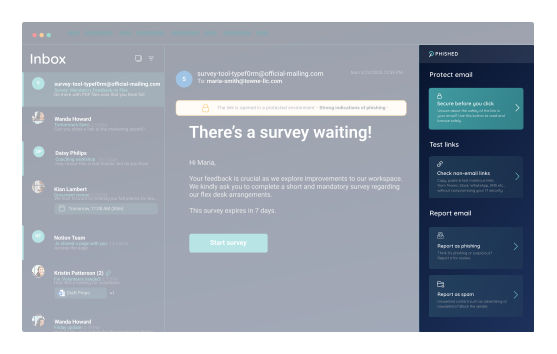
The framework: how much of your attack surface gets trained?
Think of your phishing attack surface as 100% of the moments your employees encounter a phishing risk — every suspicious email, link, SMS, or QR code. Different mechanisms reach very different shares of that surface.
Independent research presented at Black Hat 2025 supports this. In a randomized controlled trial of nearly 20,000 employees, researchers from the University of Chicago and UC San Diego found that embedded simulation training reduced the average phishing failure rate by only about 1.7% — because the training only reaches the small fraction of users who fail a given simulation (a median of just 10%), and most of those who do fail barely engage with it. Simulation-only programs correct mistakes after failure and never touch the silent majority. (Understanding the Efficacy of Phishing Training in Practice)
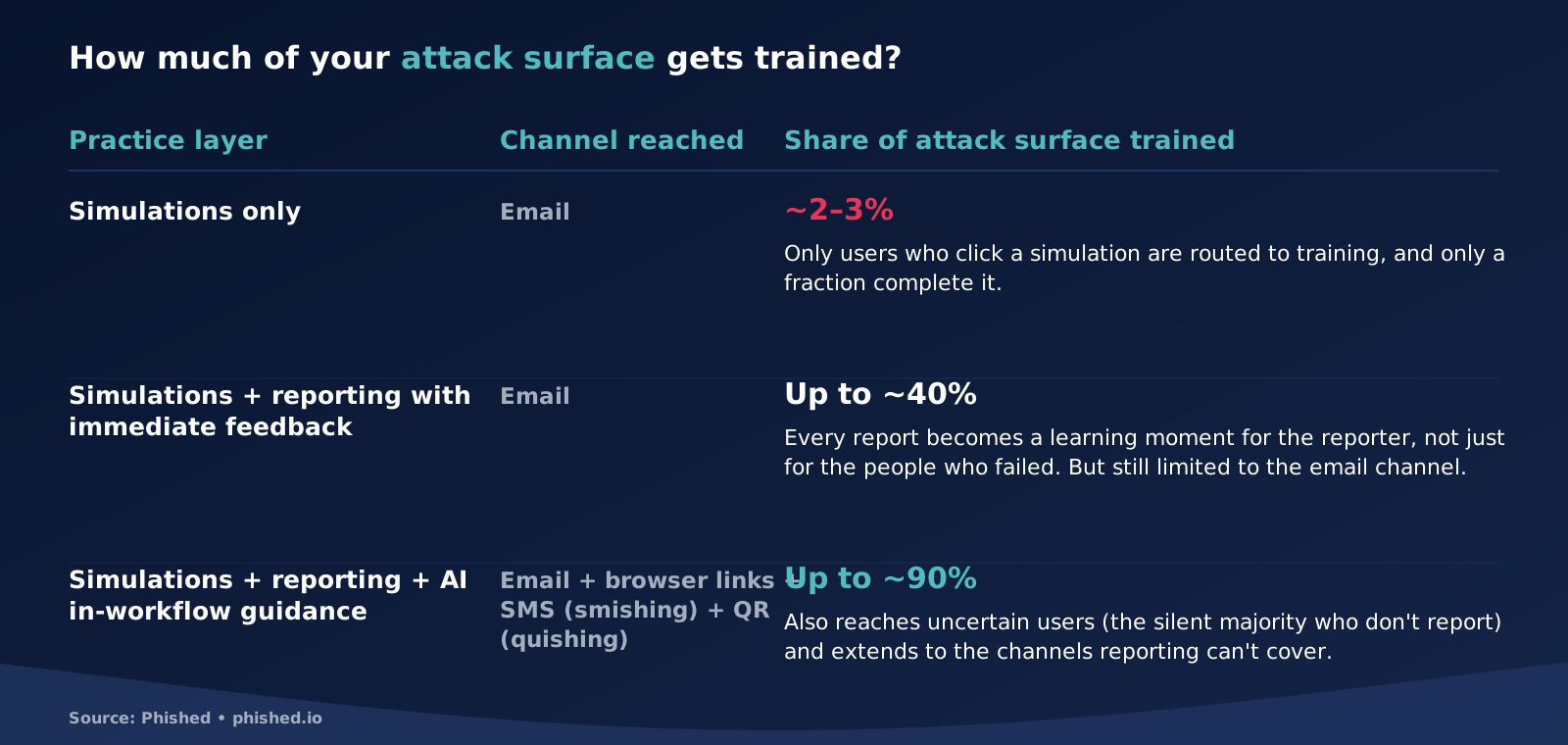
Phished vs KnowBe4: feature comparison
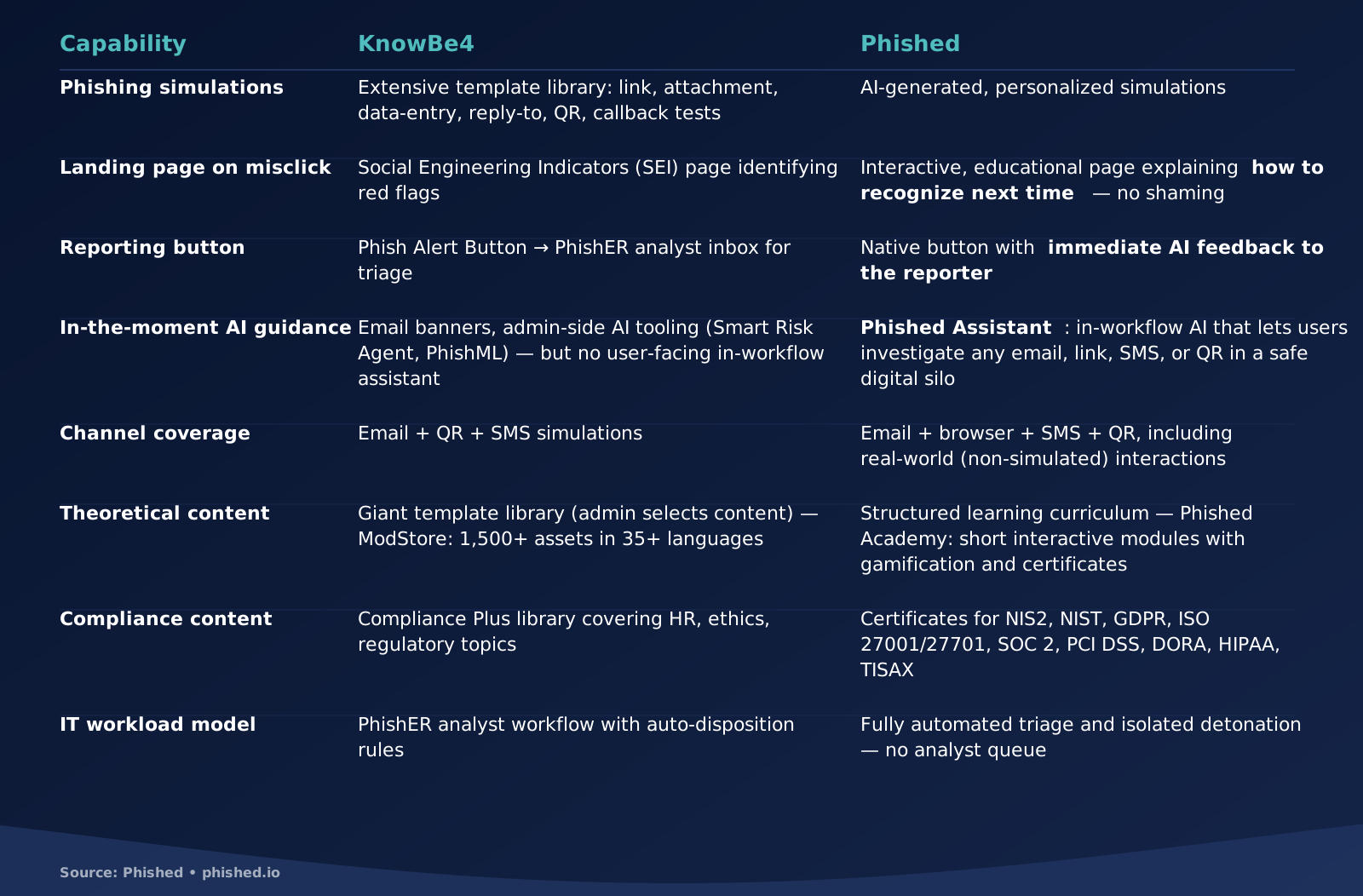
1. Phishing simulations: KnowBe4 vs Phished
Both platforms cover the same vectors, but they take opposite approaches to producing phishing simulations.
KnowBe4 leans on scale and a curated library. The ModStore holds over 8,000 phishing templates, and the platform supports 35+ languages for all training content and simulated phishing. An admin selects topics, sets difficulty, configures language overrides (up to five per campaign), and builds out waves and Smart Groups — powerful, but hands-on.
Phished automates the same work. Its AI engine automatically generates and sends personalized simulations, adapting each one to the individual employee's behavior and taking into account job role, region, language, industry, previous exposure, and optimal delivery timing. It also offers a curated baseline: a library of more than 4,500 hyper-realistic templates paired with over 300 realistic sending domains, with simulations available in over 25 languages. Admins can spin up a targeted campaign from a single prompt in any supported language, and difficulty adapts per user — harder simulations for consistent reporters, easier ones for those still learning.
Either way, simulations alone hit the same ceiling: they only train the small group of users who misclick and then complete the landing-page training. The majority never receives any behavioral input at all.
2. Landing pages: trick-and-blame or educational?
The landing page after a failed simulation is often the only moment an employee receives meaningful, in-context training. Make it count.
KnowBe4 uses a Social Engineering Indicators (SEI) page identifying the red flags missed — clear, but essentially a debrief. Phished uses interactive pages that walk the user through the email and explain how to recognize the trick next time — without shaming.
Tone matters: punitive feedback drives concealment (users won't report next time because they don't want to look stupid). Educational feedback drives the opposite — more reporting, more engagement, more durable behavior change.
3. Reporting: the most scalable training mechanism within email
Reporting is the only practice-based mechanism that can train every employee who reports, not just the ones who fail. When a user reports a suspicious email — simulated or real — the act of reporting is itself the training moment, if the platform sends back immediate, meaningful feedback. That moves coverage from ~2–3% to ~40%. The 40% ceiling is a channel ceiling: reporting only works for email.
KnowBe4's Phish Alert Button (PAB) routes reports into PhishER (Plus), which applies ML scoring and admin rules. On simulated phishing, the user does get immediate feedback. But when they report a real suspicious email, that report enters an analyst queue and the educational moment waits on human triage, so the reporter gets a confirmation rather than immediate, instructive feedback. By the time the email is dispositioned, the teachable moment has passed: the learning opportunity is lost.
Phished's report button is designed around the user. When they report a simulation or a genuine suspicious email, the AI returns an immediate verdict and reasoning. Correct report? Positive reinforcement. False alarm? Gentle explanation. Either way: a learning moment that turns reporting from a ticket queue into a training mechanism.
4. AI in-workflow guidance: the Phished Assistant vs KnowBe4
Even a well-run simulation + reporting program caps out around 40% of the attack surface for two reasons:
Reporting only fires when a user is confident enough to click "report." The silent majority — users who are merely uncertain, not suspicious enough to report but not confident enough to click — fall through and handle the message alone, at the moment risk occurs. No training reaches them.
Reporting and simulations only live inside email. Browser links, SMS (smishing), and QR codes (quishing) sit outside that loop entirely.
The Phished Assistant closes both gaps in one layer. It's an AI assistant embedded in the email client and browser. When a user is uncertain about any interaction — an email, a browser link, an SMS message, a QR code — they open the Assistant, which analyzes the content in a safe, isolated digital silo and returns a verdict with reasoning. The user investigates without risking the corporate environment.
By extending guidance to the silent majority and to the channels reporting can't reach, the Assistant moves coverage from ~40% to ~90% of the attack surface. Guidance is just-in-time, in-workflow, pre-risk, and fully automated on the IT side.
KnowBe4 has no equivalent to the Phished Assistant. Its tools inform and warn within email — but a user-facing assistant that guides the employee in the moment, across email, browser, SMS, and QR, isn't something KnowBe4 offers.
5. Training content libraries: KnowBe4 ModStore vs Phished Academy
KnowBe4's ModStore is one of the largest libraries in the SAT market: 1,500+ assets in 35+ languages, with Compliance Plus extending into HR-adjacent topics. But breadth comes with a trade-off — the admin curates the program, selecting and assigning content from that vast catalog. Phished Academy takes the opposite approach: rather than a library to pick from, it delivers a structured learning curriculum of short interactive modules with quizzes, gamification, and certifications across a security-centric compliance footprint (NIS2, NIST, DORA, ISO 27001/27701, GDPR, SOC 2, HIPAA), including project-based NIS2 implementation templates.
Prioritize breadth across security + HR/ethics in many languages? ModStore is hard to beat. Prioritize depth on regulatory cybersecurity frameworks with implementation support? Academy is purpose-built. Neither library alone changes behavior — the practice-based layer above does.
Operational workload for IT and security teams
KnowBe4 assumes a security operator who curates the program and reviews flagged reports — PhishER Plus reduces that with ML and crowdsourced rules, but the model remains analyst-centric. Phished minimizes manual triage: reports and Assistant queries are analyzed automatically, suspicious content is detonated in isolation, and there's no review queue. For lean security teams, the SAT platform stops being a source of work.
That low-overhead model doesn't come at the expense of results. IPCOS moved from roughly 50% of employees susceptible at baseline to 13% within four months — without a standing analyst queue to manage.
On integrations, both platforms cover what most IT teams check first: Microsoft 365 and Google Workspace for deployment and message injection, SSO/SAML for authentication, and SCIM or directory sync (Entra ID / Active Directory) for automated user provisioning and deprovisioning. Both also push simulation and reporting data outward to SIEM and downstream security tooling, so human-risk signals can feed the wider security stack rather than staying siloed in the SAT console.
Pricing: Phished vs KnowBe4
The two vendors take different approaches to price transparency, but in both cases there are public data points worth understanding before you ask for a quote.
KnowBe4 publishes per-user list pricing on its website, using a per-user, per-month model (billed annually) across four tiers — Silver, Gold, Platinum, and Diamond — with rates that decrease as user counts rise and as buyers commit to multi-year terms. Add-ons like Compliance Plus are priced separately. Those list rates are a starting point, not the final number: third-party benchmark data shows negotiated deals commonly land well below list.
Phished doesn't publish per-seat pricing publicly. Plans start at $175 per month for the platform — not per seat — making the entry point predictable for smaller teams rather than scaling with headcount from the first user.
Either way, the same variables drive the final cost: seat count, content tier, language coverage, and support level. Because pricing is the top reason buyers look for KnowBe4 alternatives, the practical move is to request a quote from each vendor against your real seat count, then compare total cost — not headline rates.
Which platform should you choose?
Both platforms teach the concepts competently — the right fit comes down to how your team is staffed and what you're optimizing for.
Choose KnowBe4 if you…
Have a dedicated SAT administrator or security operator who can curate the program, build waves, and review flagged reports
Need the broadest possible content library, including HR and ethics-adjacent topics, across 35+ languages
Want a mature analyst-driven workflow (PhishER) with ML scoring and custom disposition rules at the center of your triage process
Value a deep, configurable template library and don't mind the hands-on setup that comes with it
Choose Phished if you…
Run a lean security team and want simulations, triage, and detonation automated — no analyst queue to staff
Want to train beyond the 2–3% who click, reaching the silent majority who never report through in-workflow AI guidance
Need coverage across email, browser, SMS, and QR — not just the email channel
Prefer educational, no-shaming feedback that drives more reporting and more durable behavior change
Care most about the share of your attack surface that ends in a learning moment, not the size of the content catalog
If you have the staff to run a content-rich, analyst-centric program, KnowBe4 is a strong fit. If you want maximum behavior change with minimal operational overhead, Phished is built for that bet.
Phished vs KnowBe4: the bottom line
Every modern SAT platform teaches the concepts competently — the differences show up in behavior change. KnowBe4 is a mature, content-rich platform built around an analyst-driven workflow, strong for teams with dedicated SAT administrators. Phished is built on a different bet: behavior change happens at the moment of decision, not in the quarterly module. The combination of automated simulations, an immediate-feedback report button, and the Phished Assistant is designed to train up to ~90% of the attack surface* — including the silent majority who never click and never report.
If you're evaluating a KnowBe4 alternative, the deciding factor usually isn't the size of the content library — it's how your team is staffed and where you think learning actually happens. The most useful question isn't "which platform has more content?" It's: of every employee interaction with a suspicious message this quarter, how many will end with a learning moment?
*Based on internal Phished data measuring user coverage across simulations, reporting, and Assistant usage.
Phished vs KnowBe4: frequently asked questions
Is KnowBe4 better than Phished, or vice versa?
Neither is universally better. KnowBe4 has the larger content library and the deeper analyst workflow; Phished has the more advanced in-workflow user-guidance layer (the Phished Assistant) and a more automated operational model.
Does KnowBe4 have an equivalent to the Phished Assistant?
KnowBe4 offers email banners and admin-side AI tooling, but it does not currently offer a user-facing, in-workflow AI assistant for moment-of-decision guidance across email, browser, SMS, and QR.
How much of my attack surface does a simulation-only program train?
Roughly 2–3%. Only users who click are routed to training, and only a fraction complete it. The rest of the surface receives no behavioral input.
Does Phished cover smishing and quishing?
Yes. Both Phished and KnowBe4 cover smishing (SMS-based phishing) and quishing (QR-code phishing). The difference is in how employees are trained: KnowBe4 relies on simulated smishing and quishing campaigns, while Phished delivers actual training on smishing and quishing to every employee. That matters because simulations only ever train the 2–3% of people who click — leaving the rest of your staff untouched. Phished trains all employees, not just the few who fail a test.
Which platform requires less hands-on management to run?
It depends on how you want to operate. KnowBe4 is built around a security operator who curates the program and reviews flagged reports — PhishER Plus reduces that load with ML scoring and crowdsourced rules, but the model remains analyst-centric. Phished is built to minimize manual work: report triage and Assistant queries are analyzed automatically, suspicious content is detonated in isolation, and there's no analyst review queue. Teams that want hands-on control over content and workflows may prefer KnowBe4's model; teams that want to reduce ongoing administrative overhead and automate triage will get more out of Phished.
How do the platforms integrate with Microsoft 365, Google Workspace, and single sign-on?
Both connect directly to Microsoft 365 and Google Workspace for deployment, report-button delivery, and automated user sync, and both support SSO via SAML 2.0 so employees authenticate through your existing identity provider. Provisioning is automated on both — users are added when they join and removed when they leave.
About this comparison
Written by Phished. We've based the KnowBe4 details on publicly available product documentation as of June 2026.