The Top 10 Human Risk Management Platforms, Compared for 2026
The best human risk management platforms in 2026 turn a risk score into action: they measure how each person behaves and change the protection, guidance or training that person receives, rather than reporting a completion rate. Where they differ most is where they act. Phished isolates suspicious content across the entire human attack surface, from email and links to SMS, QR codes, Teams and Slack; KnowBe4 and Mimecast adjust training and nudges from their risk scores; and Living Security and CybSafe specialise in risk analytics across the security stack.
Human risk management (HRM) is what security awareness training becomes when the goal shifts from completing courses to preventing incidents. Instead of sending everyone the same modules and phishing campaigns on a fixed schedule, an HRM platform measures how each person actually behaves and adjusts its response as that risk changes.
That shift matters because the old measure of success no longer holds. AI lets attackers produce messages, voices and login pages that look exactly like the real thing, so a programme judged on click rates says little about how exposed an organisation actually is. Independent research points the same way: when researchers at ETH Zurich and the University of Chicago shared two independent studies at Black Hat 2025, they reported that phishing simulations on their own did little to change behaviour over the long term. A human risk management platform answers a different question: which people, roles and workflows carry the most risk right now, and what is being done about it at the moment it matters.
If you are looking for the best human risk management software for your organisation, this guide ranks the ten platforms that recur most often across analyst coverage, independent research and AI search answers, scored on five criteria. For a broader view of the training market, see our Top 10 Security Awareness Training Platforms in 2026. If you are specifically replacing KnowBe4, our KnowBe4 alternatives comparison covers that decision in depth.
What is a human risk management platform?
A human risk management platform measures the cyber risk that comes from how people behave, scores it per person and per group, and reduces it through targeted intervention. Instead of reporting who completed a course, it combines signals such as simulation outcomes, reporting behaviour and exposure to real attacks into a score that updates over time. That score then decides who receives guidance, training or stronger protection.
Training does not disappear in this model. It becomes one of several responses, alongside in-the-moment guidance, stricter protection for high-risk groups and, on the most mature platforms, stopping a threat before an employee's click can do damage.
The 5 key features of a human risk management platform we scored
- Protection at the moment of contact: whether the platform guides or protects an employee when they meet a real threat, or only trains them beforehand and reports afterwards.
- Channel coverage: email only, or also SMS, voice, QR, browser and collaboration tools.
- A risk score that drives action: a continuous, behaviour-based score that changes how people are protected, not only which training they get, and shows whether risk is falling over time.
- Admin workload: the effort needed for setup, campaigns, handling reported emails and reporting.
- Language and localisation support.
These criteria follow how analysts describe mature human risk management: quantify risk, intervene at the right moment, connect risk to controls and prove it is going down. Each vendor's capabilities were checked in its own product documentation, and where a platform leads on one criterion and trails on another, the entry says so. How the shortlist was built is set out in the methodology at the end of this guide.
The 10 best human risk management platforms
Phished: human risk, managed live and isolated at the source
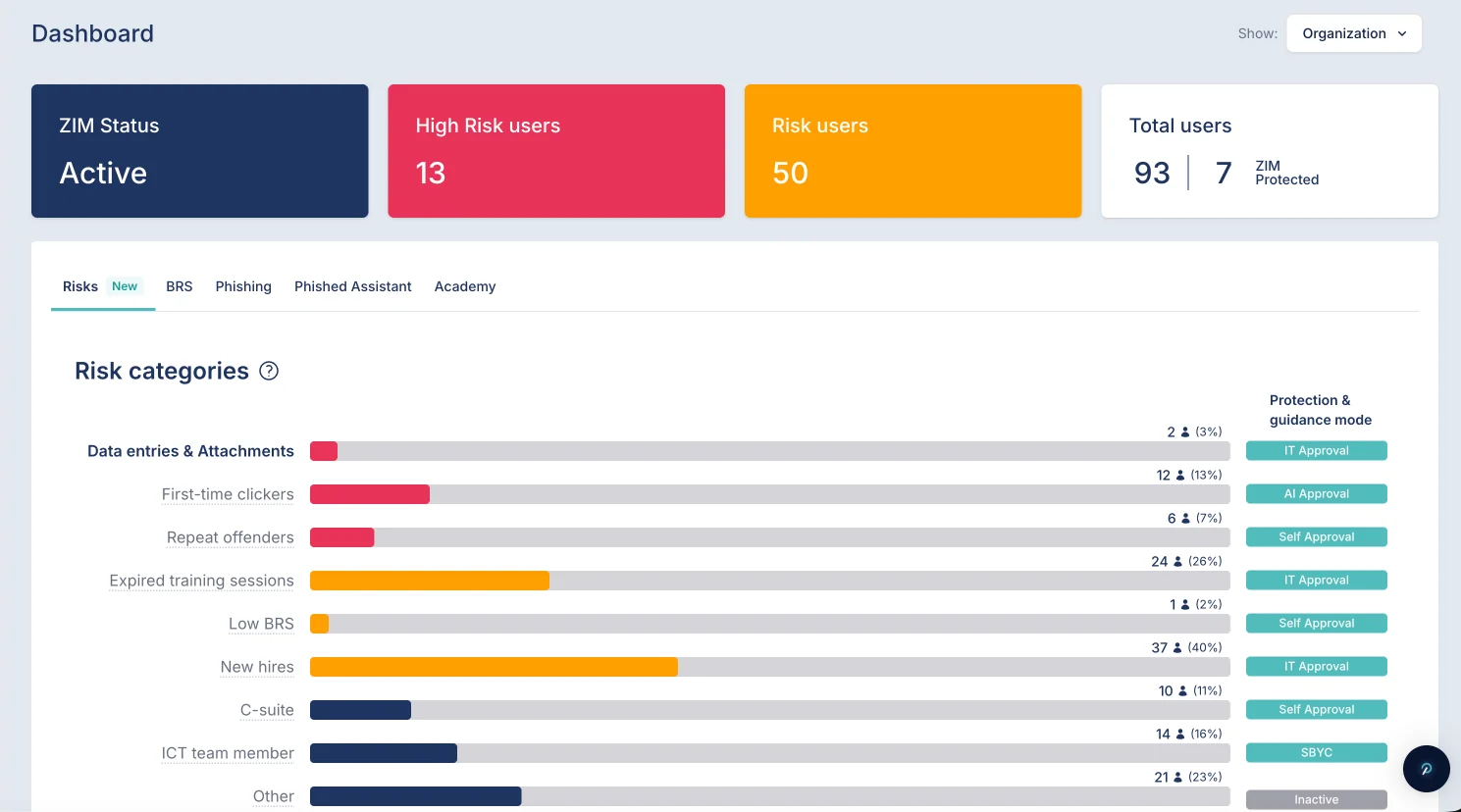
Phished is an AI-native human risk management platform with one goal: zero incidents caused by human error. Simulations, reporting and training all feed one thing: live data on how each employee actually behaves. Every employee has a Behavioral Risk Score™ (BRS) that updates continuously. The platform automatically sorts the organisation into the groups that matter, such as first-time clickers, repeat offenders, new hires and low-BRS employees, and keeps them current as behaviour changes. Most platforms stop there and hand over a quarterly report. Phished's risk dashboard is a control surface instead. For each group, admins set the level of protection, from in-the-moment guidance up to opening every incoming email in isolation for the highest-risk users. Protection can start with a single group, such as repeat offenders or the C-suite, so teams can see the effect on incidents and risk scores before extending it to everyone else.
The biggest difference is isolation. When an employee is unsure about something, the Phished Assistant opens it in a sealed digital silo, away from the device and the network, where AI analyses it and gives a verdict before anything executes. Even a threat that slipped past every filter cannot reach the infrastructure. It is zero trust applied to the human layer, and Phished is the only platform in this guide that isolates content this way. Phished has filed a global patent application for the technology.
Pros
- Protection scoped to risk: switch on the Assistant or Zero-Incident Mail™ for one high-risk group first, see the impact, then extend it with a click instead of a big-bang rollout
- Trains the hesitant majority, not just the ~10% who click: instant feedback on every report, real or simulated, and a safe verdict in the silo across email, SMS, QR codes, Teams and Slack
- Around 99% of reported emails resolve automatically. The ~1% that needs a person arrives with a recommended response, and the onboarding wizard gets you running within 30 minutes
Cons
- The integration catalogue is still growing, so teams with a very broad security stack should confirm the connectors they need
- Built around behaviour change rather than a vast course catalogue, so teams that mainly want thousands of off-the-shelf modules to choose from will find a more focused library
- The biggest gains come from enabling the Assistant's protection layer; running simulations alone uses only part of the platform
KnowBe4: the largest content library in the category
KnowBe4 reports more than 70,000 customer organisations and has rebuilt its offering as HRM+, combining awareness training, cloud email security, crowdsourced anti-phishing and a suite of AI Defense Agents (AIDA). Its SmartRisk Agent scores users on 316 indicators across 37 factors, and newer agents automate simulation delivery and generate deepfake training content.
It ranks second on breadth and scale: its content library is the largest in the category and its language coverage is among the widest in this guide. SACR's 2026 market map still places KnowBe4 in the engagement and awareness layer of HRM rather than the risk-intelligence layer.
Pros
- Largest customer base and content library in the category
- Long enterprise track record, which can ease procurement in large organisations
- 35+ languages across training and simulated phishing
Cons
- Risk scoring is layered onto a training-centric platform rather than built as its core
- A large library needs active curation to stay relevant
- Employees have no way to check a suspicious message safely before they act; protection relies on training and email filtering
Living Security: human risk correlated across the security stack
Living Security was one of the two Leaders in Forrester's first HRM Wave (Q3 2024). Its Unify platform calculates a Human Risk Index by correlating, by its own count, more than 300 signals across employee behaviour, identity and access systems, and threat intelligence. Forrester has also named it among the vendors giving real-time visibility into how employees interact with generative AI tools.
That depth depends on what you connect, and it comes with more set-up and integration work than most platforms here. Living Security is strongest at showing where risk sits; it does less for the employee at the moment a threat arrives, which keeps it behind Phished and KnowBe4.
Pros
- Risk index adds identity and threat-intelligence data to behavioural signals
- Visibility into employee use of generative AI tools
- Simulations across phishing, smishing and vishing
Cons
- Value scales with the integrations already in place, so leaner stacks see less of it
- Pricing is quote-only, with modular enterprise packages
- Focused on detection and prioritisation; no isolation or verdict for the employee at the moment of contact
Mimecast: human risk tied to email, collaboration and insider-risk data
Mimecast was a Strong Performer in Forrester's 2024 HRM Wave and, by Mimecast's account, received the highest possible scores for human risk quantification and for external integrations. It models risk as a combination of actions, attacks and access, and has built out that model through the acquisitions of Elevate Security, Aware and Code42. Its Human Risk Command Center adjusts training assignments automatically as risk scores change and sends nudges over email, Slack or Teams.
Most of that value connects back to Mimecast's own email security, which makes it a stronger fit for existing customers than for buyers starting fresh.
Pros
- Risk model spans behaviour, attack exposure and access
- Insider-risk and collaboration-security data from acquired products
- Library of 200+ modules in 27 languages
Cons
- Delivers most when you already run Mimecast email security
- Simulations and nudges stay email- and chat-led; SMS, QR codes and browser threats are not covered
- Pricing is bundled or quote-based
Hoxhunt: adaptive phishing simulation as the risk signal
Hoxhunt builds its human risk picture from how each employee handles adaptive, personalised phishing simulations, backed by microlearning and gamification that keep participation high. It was named a Customers' Choice in Gartner's 2024 Voice of the Customer for Security Awareness Computer-Based Training and supports 30+ languages.
Because the signal comes mainly from phishing behaviour, Hoxhunt is strongest as a phishing-resilience engine and narrower as a broad human risk platform.
Pros
- Simulations adapt to each person's behaviour and skill level
- Gamification that sustains reporting and participation
- Gartner Peer Insights Customers' Choice, 2024
Cons
- Risk model centres on phishing behaviour rather than identity or access data
- Pricing is fully quote-only
- No inbox-level protection or in-the-moment verdict when a real threat arrives
Proofpoint: human risk weighted by who is actually being attacked
Proofpoint scores human risk with data from its own email security: which employees are actually being targeted. People Risk Explorer combines that attack exposure with behaviour and privilege to surface high-risk users, and SACR places Proofpoint across the risk-intelligence, testing and control-linkage layers of its HRM map. Its awareness library spans 600+ modules in 40+ languages.
That advantage is tied to the Proofpoint ecosystem. Outside it, the attack-exposure signal that makes the scoring distinctive is largely missing, and the platform offers little for the employee at the moment of contact or beyond email, which keeps it in the middle of this ranking despite strong risk analytics.
Pros
- Risk scores informed by real attack targeting, not only simulation results
- Connects human risk to email security, DLP and insider-risk controls
- Strongest language support in this guide (40+)
Cons
- Much of the value disappears outside the Proofpoint ecosystem
- Pricing is not published
- Email-centric; no isolation or guidance layer for SMS, QR or browser threats
Adaptive Security: built for deepfake and AI impersonation
Adaptive Security, founded in 2024 and backed by Andreessen Horowitz and the OpenAI Startup Fund, focuses on the attacks AI has made cheap: deepfake voice, video, SMS and email impersonation. It simulates those scenarios, scores risk after every click, call or report, and triages messages employees report.
It is the youngest platform in this guide and deliberately narrow, which makes it a strong specialist layer for social-engineering exposure rather than a full HRM programme.
Pros
- Realistic deepfake simulations across voice, video, SMS and email
- Deepfake scenarios tailored to executives, finance and help-desk staff
- Fast-moving product with strong investor backing
Cons
- Shortest track record in this guide
- Scope centres on social engineering rather than broader security behaviour
- Pricing is quote-only, licensed per seat per year; language coverage is not published
SoSafe: behavioural engagement with EU data residency
SoSafe was a Strong Performer in Forrester's 2024 HRM Wave, where, according to SoSafe, it received top scores for innovation, psychological considerations and privacy. Its Human Risk OS brings awareness, behaviour and culture metrics into one view, and its AI copilot, Sofie, sends nudges and alerts inside Teams and Slack. All customer data is processed within the EU.
SoSafe's strength is engagement and privacy by design. Its risk model is built mainly on training and simulation behaviour, rather than identity or attack-exposure data.
Pros
- EU-only data processing for GDPR- and TISAX-bound buyers
- Nudges delivered inside Teams and Slack
- Microlearning built on positive psychology to keep friction low
Cons
- Pricing is quote-only
- No protection layer beyond training, simulation and nudges
- Gamified tone does not suit every corporate culture
CybSafe: behavioural science as the scoring engine
CybSafe was the other Leader in Forrester's 2024 HRM Wave. Its scoring is built on SebDB, a security behaviour database developed with academic, government and industry input that maps specific security behaviours, such as MFA use or password practice, to risk-related outcomes. The platform pulls behaviour and sentiment signals from across the tech stack and responds with targeted nudges and automated workflows.
The result is a programme that can explain why a behaviour score matters, which is useful when the audience is an auditor or a board. It ranks lower here because its interventions are guidance and nudges across a narrower set of channels, with no protection layer when a real attack lands.
Pros
- Behaviour-to-risk mapping grounded in a published research database
- Measures behaviours beyond phishing, including data handling and authentication
- Automation and orchestration of nudges and follow-up
Cons
- Pricing is quote-only for each of its products (Guide, Phish and Respond)
- Less emphasis on simulation realism and channel breadth than phishing-first platforms
- No protection layer that stops a live attack; interventions are guidance and training
OutThink: human risk intelligence linked to conditional access
OutThink, a London-based vendor founded in 2019, combines identity, attitudes, threat intelligence, security behaviour and access permissions into a human risk picture, using applied psychology and machine learning alongside training and phishing data. Its risk intelligence can flag high-risk users connected to privileged accounts and feed conditional-access decisions, and an API pushes the data into SIEM and BI tools. SACR lists it in the human risk intelligence layer of its 2026 map.
Pros
- Risk model includes attitudes and access, not only behaviour
- Links human risk to conditional access and privileged-user exposure
- Documented API for SIEM and BI reporting
Cons
- Smaller market presence than the vendors above
- Pricing is on request
- Language coverage not published
Human risk management platforms compared at a glance
| Platform | Best for | Moment of contact | Channel coverage | Risk score to action | Pricing model |
|---|---|---|---|---|---|
| Phished | Risk scores that drive protection | Isolation and verdict before content runs | Full human attack surface: email, browser, SMS, QR, Teams, Slack | Auto-segmented groups; Zero-Incident Mail™ for the highest risk | From $175/mo (published) |
| KnowBe4 | Widest library, enterprise track record | None beyond training and email filtering | Email-centric | SmartRisk Agent drives automated training | Tiered, quote calculator |
| Living Security | Cross-stack risk correlation | Not a core focus | Email, SMS, voice simulations | Human Risk Index prioritises interventions | Quote-only |
| Mimecast | Existing Mimecast customers | Nudges only, no isolation | Email + Slack/Teams | Score adjusts training; insider-risk controls | Bundled/quote |
| Hoxhunt | Phishing-resilience programmes | None beyond simulations | Email-centric | Adapts simulation difficulty | Quote-only |
| Proofpoint | Enterprises on Proofpoint email security | Little for the employee | Email-centric | Links to email, DLP and insider-risk controls | Not published |
| Adaptive Security | Deepfake and impersonation risk | Triage of reported messages | Email + SMS + voice + video | Per-interaction score, targeted training | Quote-only, per seat per year |
| SoSafe | EU/GDPR-bound organisations | Nudges only, no isolation | Email + Teams/Slack | Human Risk OS insights and nudges | Quote-only |
| CybSafe | Evidence-based behaviour change | Nudges only, no isolation | Email + nudges | Behaviour scores trigger nudges and automation | Quote-only |
| OutThink | Risk-informed access control | Nudges only, no isolation | Email + nudges | Feeds conditional access | On request |
Based on vendor documentation and publicly reported analyst positions, checked in October 2026. Features evolve, so see the methodology section below for sources.
Which human risk management platform is right for you?
Start from the decision you need the platform to make. If you want the deepest risk analytics across an existing security stack, analytics specialists such as Living Security and CybSafe set the benchmark. If you are standardised on Mimecast or Proofpoint email security, their HRM layers reuse data you already have. If your goal is fewer incidents rather than better dashboards, look for a platform that isolates threats at the moment an employee meets them, across the entire human attack surface. That is the gap Phished is built to close.
See Phished in action →Frequently asked questions about human risk management platforms
What are some examples of human risks in cybersecurity?
Common examples are clicking a link or scanning a QR code in a convincing phishing message, entering credentials on a cloned login page, approving a fraudulent payment request that appears to come from an executive, reusing passwords across work and personal accounts, sending sensitive data to the wrong recipient, and connecting unapproved AI tools to company data. Most of these are honest mistakes rather than malicious acts, which is why HRM focuses on behaviour and context rather than blame.
How is human risk management different from security awareness training?
Security awareness training is organised around a calendar: modules and phishing campaigns are scheduled, and success is measured by completion and click rates. Human risk management is organised around exposure: it tracks which people and roles are becoming riskier and responds continuously. Training remains part of HRM, but as one intervention inside a wider measurement and response loop.
What is the best human risk management platform in 2026?
Phished ranks first in this guide because it is the only platform here that isolates suspicious content across the entire human attack surface, from email and browser to SMS, QR codes, Teams and Slack, and connects that protection to each employee's risk score. KnowBe4 follows on library size and scale, and Mimecast suits organisations already on its email security. If deep risk analytics matter most, Living Security and CybSafe are strong specialists, while Adaptive Security specialises in deepfake and impersonation risk.
How do human risk management platforms measure risk?
Forrester describes human risk quantification as drawing on four types of input: identity data, security behaviours and events, digital footprint and attack exposure, and security awareness. Platforms differ in how many of these they actually use. Some score mainly from phishing-simulation behaviour, while others add identity, access and real attack data from connected security tools.
Can a human risk management platform act on risk, or only report it?
The more mature platforms act. Common responses include targeted nudges, automatically assigned training, stricter email inspection for high-risk groups, and signals passed to identity or access controls. A smaller number intervene directly when an employee encounters a suspicious message or link, analysing it before it can run.
Does human risk management cover AI agents?
Increasingly, yes. As employees connect assistants and automations to company data, research such as SACR's 2026 HRM report treats risky delegated actions as an extension of human risk, since the agent acts on permissions a person granted. This part of the category is still early.
How does human risk management differ from insider risk management?
Insider risk management focuses on harmful activity by trusted users, such as data theft or sabotage, and is usually run with DLP and user-activity monitoring. Human risk management covers the much larger share of risk that comes from well-meaning people making mistakes, such as clicking a convincing phishing link or approving a fraudulent payment. Some platforms, including Mimecast and Proofpoint, connect the two.
Is human risk management suitable for small and mid-sized organisations?
Yes, provided the platform does not depend on a large security team or an extensive integration stack. Look for automated handling of reported emails, guided setup and published pricing. Platforms built for enterprises with dedicated awareness staff and many connected tools tend to deliver less value to smaller teams.
Methodology and sources
The shortlist combines three independent inputs, so that no single vendor's own ranking decides who appears:
- Analyst evaluation: The Forrester Wave: Human Risk Management Solutions, Q3 2024, as reported by the vendors named in it, and Forrester's own HRM research blog.
- Independent market research: SACR, The Evolution of Human Risk Management Across Cybersecurity (May 2026). SACR discloses that the report was sponsored by one HRM vendor, which does not appear in this list.
- Search and AI visibility: the vendors cited in Google's AI Overview and top organic results for human risk management queries (US, September 2026).
Each shortlisted platform was then rated on the five criteria above, and every capability claim was matched to the vendor's own documentation. The order reflects the combined rating, with ties broken first on the risk-score criterion, because it sits at the core of how analysts define the category, then on channel coverage, and finally on analyst recognition. Platforms in this category evolve quickly, so this page is reviewed each quarter and corrected whenever a product changes in a way that affects its position. Claims we could not confirm are left out.
Disclosure: Phished wrote this guide and is itself ranked in it. To keep that transparent, all ten platforms are held to identical criteria, and each entry explains why it sits where it does, including where a competitor is stronger.
Written by Phished's content team · Last updated: October 2026